Pages

Showing posts with label economics. Show all posts

Friday, May 19, 2017

Breaking Down Obamacare, Or: Everything You Wanted to Know About the ACA but the Inept News Media was too Incompetent to Tell You

As per usual, partisan differences leave citizens caught in the middle.
Last week, the House passed a bill to repeal Obamacare. The Congressional Budget Office was unable to evaluate the bill so it is unclear how many people will be negatively impacted if the bill in its current form passes the Senate and is signed into law.
Source:
https://en.wikipedia.org/wiki/Patient_Protection_and_Affordable_Care_Act#

While Obamacare has problems. repealing it, absent any comparable replacement, would be a disaster. This is because Obamacare remedies some major flaws in the health care system. And although our health care crisis did not cause the economic collapse of 2008, it has been a major factor in recovering from what was the deepest recession since the Great Depression. Continue reading for the full breakdown...

I. Funding

Tax Increase On the Wealthy
In my opinion, the biggest flaw of Obamacare is that the subsidies that allow poor and middle class Americans to afford health insurance is partly funded by taxes paid by wealthy people (through taxes on Cadillac health care plans, which is currently delayed, and other taxes as well as cost savings). This means that the law will always be a target for repeal because wealthy people, like the rest of us, generally want their taxes to be as low as possible. [A brief history: the wealthy people of today succeeded in part due to the opportunities afforded our generations by the generations of wealthy
people before us. We all for the most part succeeded because of their generosity, vision and patriotism. We were able to build a country that had the best school system in the world. We had the best infrastructure in the world. Healthcare, manufacturing, agriculture; we were Number One at just about everything. But the wealthy people of today don't want to pay the kinds of taxes that can sustain what we once had and what we once were. Their taxes have been radically reduced over the past few decades, leaving the middle class with the burden of making up the gap while losing services due to lack of funding.]

The political influence of today's wealthy people in our politics is so substantial that Republican politicians have spent over $50 million of our tax dollars holding votes on bills to repeal the ACA. The repeal bills never had any hope of being signed into law, so you and I and everyone we know paid $50 million for Republican politicians to declare to their wealthy campaign donors that they were strongly against Obamacare. It was simply a way of ensuring that they would be showered with campaign cash in upcoming elections. When it comes to health care, Republicans have refused to lead, follow or even get out of the way.

II. Performance

State-by-State Variances
Obamacare's performance differed widely by state. States like Kentucky and California that embraced the law, expanded Medicare and set up state-wide insurance exchanges saw a large decrease in the rates of uninsured citizens and a reduction in the rate of rise of insurance premiums. Other states have experienced less success. Nationwide, Obamacare helped to slow the rate of increase to insurance premiums. People who got their health insurance from their employers, rather than through Obamacare, seemed to enjoy a slight reduction in actual health care costs.

Source: http://www.consumerreports.org/personal-bankruptcy/
how-the-aca-drove-down-personal-bankruptcy/
Personal Bankruptcies
One of Obamacare's largest positive impacts was effectuating an astonishing 50 percent decrease in personal bankruptcies. While Obamacare is not likely to be the only reason for the reduction in bankruptcies, experts believe that it is likely to have been the largest driver of that trend. When people got access to affordable health care, they were able to get needed medical treatment and pay their other essential bills. Unfortunately, I don't know how to evaluate the broader economic impact of preventing nearly 800,000 bankruptcies in the country but it would almost certainly mean a reduction in dependency on government services like food stamps and welfare. It would also mean avoiding a negative impact on productivity and our GDP. It certainly seems like fewer bankruptcies would mean a stronger economy overall.

III. Republican Attacks

Repeal Votes
While Republicans have attempted to say that Obamacare is collapsing under its own weight, the truth is that they have made every imaginable attempt to undermine the law. Had Republicans not wasted $50 million voting on bills that aimed to repeal it, that money could have been used to help solve deficiencies with the law or to fund more subsidies for those who cannot afford their insurance premiums.

Advising to Pay Penalties
When the law first passed, Republican politicians and pundits recommended that their constituents and followers pay the fine and get nothing rather than buy insurance through the ACA and actually have health insurance. This was not because they thought it would be the better choice for the individual. It instead was another tactic to undermine the law. They knew that the more people that signed up, the more likely it would succeed. There is something very disgusting about wealthy people who have great health care trying to achieve their political ends by telling people to forego health care coverage.

De-funded Risk Corridors
The fatal blow to Obamacare may have been delivered by Rep. Jack Kingston (R-Ga.), when he snuck an amendment into an unrelated bill that de-funded the risk corridors. There is some debate about this issue so I will break it down as I understand it: the risk corridors were set up to make sure that insurance companies didn't lose money by offering coverage to poor and sick people. In the past, those people simply would not be able to secure insurance coverage for themselves so the risk corridors were a way of bringing insurance companies into the program and to allow the poorest and sickest among us to finally get health care.

Democrats said that the risk corridors were going to be self-funded. Meaning that if Highmark made $5 million of net profit in the exchange selling policies to people in California and Humana lost $1 million selling policies to people in New Jersey, Highmark would share some of their profits with Humana so that Humana would not lose money by participating in the exchange. The amendment required that the risk corridors be self-funded, as the Democrats said they would be. This means that the government could not step in with money from other programs to pay the insurance companies if there was not enough money in the risk corridors to compensate all of the losses. In the first few years of the law's existence, it is extremely difficult for insurance companies to know how much to charge customers for premiums because there was no way of knowing how many sick people and how many healthier people would be signing up. Requiring that the risk corridors be self-funded meant that if the insurance companies were incorrect about their cost estimates, they would lose money in the exchange and they may not get compensated. [FYI: all of these insurance companies are incredibly profitable overall, but the challenge of figuring out how to make a profit by offering insurance to poor people is obviously difficult.]

Ramming it Down
Republicans said that Democrats had rammed the ACA down American's throats. This was a way of reinforcing a negative opinion of the law with citizens but it was never really true. Democrats held over 30 bipartisan hearings and allowed dozens of amendments to the law, in a process that took fourteen months. In the end, it passed with no Republican votes but the Republicans' fingerprints were all over it. Democrats started with the compromise position of using two conservative principles as the foundation of the law: the individual mandate and the private insurance exchange. Republicans railed against the individual mandate, even though it was their own invention. [Once, while reading Vultures Picnic by Greg Palast, I encountered a passage that said that the Koch brothers came up with cap-and-trade as a way of using free market constructs to get corporations to pay for the environmental damage that their businesses cause. I had to set the book down to contemplate why the Kochs would propose this solution, then fight it so vociferously years later. It suddenly occurred to me that it was a stall tactic. A successful one. Democrats worked to figure out ways to implement this system and how to make it work and when they are finally ready to pass legislation, the conservatives reverse their position, proclaiming that such a law would be un-American and would destroy the economy. Republicans have successfully stalled any further regulation of pollution for more than fifteen years. The same stall tactic seems to have been used to oppose the ACA.]

IV. Democratic Failures and Incompetence

Bad Optics
Who was health care reform intended to help?
Many of Obamacare's problems are undoubtedly the result of corruption and incompetence of Democrats and of Obama. The health insurance companies, pharmaceutical companies and hospital associations were invited to have input on the drafting of the bill which smacked of corruption and therefore tainted people's opinion of the law.

Poor Messaging
Democrats did a poor job of selling Obamacare to the nation. They allowed Republicans to get out in front of them and brand the legislation and set the framing for it. Republicans called it a government takeover of health care which isn't really true. They system never departed from the concept of citizens paying private insurance companies to manage health care provided by private health care providers. Government involvement only comes into play when a person cannot afford to pay their private health insurance premiums. The government gives subsidies in such cases. While some people embraced Obamacare, many opposed it, either because they didn't want government involvement in health care or because they felt that the law should have done more to provide health care to people and to cover more people.

The Invisible Three-Pronged Approach
In the book Confidence Men, Ron Suskind wrote that Obamacare was a way of tackling three major problems with a single action. We would put some of the eight million people that had lost their jobs in the economic collapse back to work in the health care delivery industry and create new demand therein by providing access to health care for many of the 50 million people who were without it. At the same time we could reform the health care system so that it was more efficient, more accountable to patients and would not leave people without access to needed services. It was a way of killing three birds with a single stone but Democrats are too incompetent to convey that message. Instead, they were always on the defense as they tried to shoot down ludicrous notions such as the law having "death panels". The soundness of the three-pronged strategy may have been convincing for many voters but they were unlikely to know anything about it if they didn't read Suskind's book. In the hundreds of articles about Obamacare that I've read over the years and in the many interviews with politicians I've seen, only in Confidence Men did I learn anything about this three-pronged approach.
Source:
https://en.wikipedia.org/wiki/Patient_Protection_and_Affordable_Care_Act#

Job Creation
So how well did the job creation aspect of Obamacare work? In an analysis, it was determined that more than one million of the new jobs created after passing of the law were in the health care industry. And Obamacare created compliance and advisory jobs in other industries as well. It would have been very difficult to reduce the unemployment rate by 5.6 points without some very large initiative such as health care reform. I certainly never heard any other plan from a politician that could have come close to being the jobs engine that Obamacare became. (The one other plan was Obama's Green Energy initiative but that was stalled in Congress. Trump's infrastructure plan may also result in a substantial employment increase but there has been little action on it and few details about the plan.)


Disastrous Rollout
The rollout of Obamacare was a disaster due to the web site for patients to sign up constantly crashing and being unable to handle the traffic. Many people tried for hours and could not complete their registrations. This was an unexpected and embarrassing failure because Obama got elected in large part to his campaign's embrace of technology and use of social media. Technology was skillfully wielded to get an advantage during the campaign but when it came to actually doing the people's business, the administration seemed incompetent.


Keeping Your Doctor and Insurance Plan
As we watched the debate over health care unfold, Obama did something unexpected and befuddling. With constituents across the country angry over the health care bill and misinformed by Republican lies about death panels and that undocumented residents would be able to access benefits from the program, Obama emerged to reassure everyone that if they liked their health care plan, they could keep it. And if they liked their doctor, they could keep their doctor. The statement was a bit like promising someone that you will never die. A grandfather clause in the law stipulates that people can keep their health care plan if they want to (even if it doesn't comply with the basic requirements of coverage in Obamacare). But there is nothing in the law that requires an insurance company to continue to offer a plan that a customer wants to keep. Nor is there anything in the law that prevents doctors from leaving an insurance network, retiring or dying.

My guess is that Obama wanted to convey the true fact that there is nothing in Obamacare that takes away anybody's insurance plan or prevents them from seeing the doctor they like. I also believe that Obama was intentionally misleading with his statements and that he understood that people would believe that they could not lose their doctor or insurance plan under any circumstances. I think that Obama sunk to this low and ill-advised position because he was exasperated by all of the lies that were being told by Republican politicians and conservative pundits about the law.

Obamacare gave small business employers the ability to get out of the practice of providing health care for their employees. Many small businesses relieved themselves of the burden but the change up in payers meant that many of these people would lose the coverage they had and would be forced into another plan. Their preferred doctor may not be in the network of the new insurance company so many lost access to their preferred doctor as well.

The Individual Mandate
The individual mandate is undoubtedly the most despised part of the Affordable Care Act. It requires that all citizens have health care coverage or pay a penalty. The penalties started at just $90 but increased over time. It is a slap in the face to every person who cannot afford health care coverage. Thousands of people ended up having to pay fines of a few hundred dollars simply because there were no affordable health care insurance options available for them. Especially in states where the Affordable Care Act was not supported by politicians, few insurance providers bought in to the program and therefore there were few options and little competition for health care plans.


V. My Personal Experiences

Doctors and Insurance Companies Denying Coverage
I supported Obamacare because when I was 22 years old, I was denied an MRI exam by my HMO doctors because they knew that they could get bonuses and other financial incentives to deny me care and save the insurance company money. This is an absurd situation that no American should be subjected to but there were millions of us that were. Many of them died from their inability to get the health care benefits covered by the insurance plans that they paid for.

If Republicans had come up with legislation that prevented this from happening to more people, I would have supported that legislation. But Republicans did not care about the millions of patients harmed by the practice. Insurance companies are the constituents of the Republican Party and they weren't complaining about the situation so Republicans had no interest in addressing the problem.

When Republicans had the opportunity to "repeal and replace" Obamacare--as they campaigned on doing in the 2016 election--they had nothing with which to replace Obamacare. After seven years of attacking and trying to destroy the law, they had not taken a single step to draft legislation to address any of the serious health care failures that Obamacare corrects.

~R. Charan Pagan
information systems technologist, musician, writer, filmmaker
Los Angeles, CA 90017

http://www.reclaimingourbirthright.blogspot.com/

Friday, November 11, 2016

My Pussy or My Democracy

Trump, the Republicans' Trojan Horse
I don't have a pussy but, if I did have one, I think I would prefer someone grabbing it without my permission than to have someone actively working to undermine our democracy. I think that is a big part of what we saw with the Trump victory this week, when white women and even some minorities voted for Donald Trump in surprisingly large numbers. I cannot vote for someone that is actively working to undermine democracy. That was the main reason that I could not vote for Hillary Clinton.

As Americans, we hold democracy sacred. And while it is always tampered with and manipulated in every election, I believe that the revelations of the Clinton campaign's meddling in the elections and conspiring with the news media to elevate Trump and other "extremists" during the Republican Party primaries cemented the public's view of Hillary as being untrustworthy. But not just untrustworthy. She was caught attempting to undermine democracy with this and numerous other tactics. To every American, that should be sacrilege.

The media was largely asleep on the job when it came to the Trump campaign conspiring with the FBI to harm Clinton's campaign. But Trump being an "outsider" to politics would likely have gotten a pass on that, even if it were widely reported. There is something especially distasteful about a politician being placed in a position of power and then violating that sacred trust.

So we slayed the three-headed dragon that is neo-Liberalism, media collusion with political operatives and the Clinton cabal. And in doing so, we've unleashed a six-headed dragon upon the world. With no record of accomplishment or any indication of competence, Trump is a Trojan horse for the Republican Party. Trump's platform and plan for his first 100 days includes items that the Republicans have been trying to get passed for decades but have been unsuccessful. Most notably are proposals to build the Keystone XL pipeline, to further cut taxes on the wealthy and to repeal Obamacare.

Republican presidential candidates have not been able to win the popular vote since the 1980s. Let that sink in for a moment. At least two of the Republicans' three 'wins' since the '80s were the result of election tampering. A strategy for wealthy donors to superfund Republican candidates for state legislatures after the 2010 census resulted in more Republicans getting elected and therefore charged with re-drawing Congressional district maps. The maps were heavily gerrymandered to benefit Republicans in future Congressional House elections. In the past few elections, Republicans have won more seats in the House although the Democrats won more votes.

Constantly rebuked at the polls, the Republican Party scored big by having Trump run in their party and to win the nomination. Now, the Trump supporters that trust everything he says--even though he's been proven to be a compulsive liar--are eager to support the policies that they rejected repeatedly when proposed by Republican "insiders".

There are a some very good parts of Trump's platform too. Unfortunately, they would require Trump to convince members of Congress to slit their own throats, such as the plans to impose term limits on members of Congress, to close the revolving door between Congress and lobbying firms and to strengthen ethics rules for the legislature. Some of these things could get done through state conventions but I do not credit Trump with the intelligence to know that. Even if he figures it out, I don't see him spending the political capital on these efforts. If I am wrong and Trump actually accomplishes these things, it could potentially make his presidency a net positive change for the country, no matter how badly he may screw up everything else. I say this because, to my knowledge, these issues have never been part of a major party 's platform.

There are many reasons that I'm so skeptical of Trump's sincerity on these issues. They would be major benefits to the American people yet Trump has hardly spoken about them in any of the debates or on the campaign trail. That is strange for a candidate that considers himself a populist. You may also recall that Trump complained many times that the Republican primary was rigged against him when the Republican establishment tried every parliamentary tactic imaginable to bump Trump from the lead and knock him out of contention for the nomination. Trump had a legitimate complaint but, once he won the nomination, he declared that he no longer cared that the primary system is rigged. For those perceptive enough to hear that dog whistle, it was a clear statement to reassure the Republican and Democratic establishment that if he became president, he would not try to fix the election system that benefits the Republican/Democratic duopoly and steals democratic power from citizens. This does not sit well with me since I do still care about our elections not being fair, accurate and transparent. Trump knowing how undemocratic our election system is and not caring enough to try to fix it is a good clue as to where his loyalties actually lie.

So where are we headed in the next four years? It's really anybody's guess. Trump's positions turn 180 degrees at any moment so he may do the opposite of what he campaigned on. I think the most likely outcome is that the Republican Party wish list will get passed immediately and the policies that are actually populist will languish and be forgotten about. In a few years, Trump will give his last State of the Union Address and list his accomplishments as president: Tax cuts for the rich! Pipelines to benefit the rich! Deregulation to benefit Wall Street and polluters! Hopefully, fixing the VA will make that list but I'm not going to hold my breath on that.

~R. Charan Pagan
information systems technologist, musician, writer, filmmaker
Los Angeles, CA 90017

http://www.reclaimingourbirthright.blogspot.com/

Friday, July 22, 2016

Examining Donald Trump's Harebrained Schemes

Donald J. Trump (our next president?)


Donald Trump became the Republican nominee at their convention in Cleveland, OH this week. The convention had its controversies, scandals and surprises.

Unsurprisingly, Trump again proposed to build a wall on the border of Mexico and to deport all of the country's undocumented workers. And he again pledged to be tough on terrorism. These are two of Trump's most notable positions and two that can use very close examination...

I. BORDER WALL AND IMMIGRATION POLICY

Trump's idea to build a wall on the border of Mexico is a position tailor made for the ignorant. Although we do need to be able to control our border and know who is entering our country, there are many reasons why blaming illegal immigrants for our country's problems and proposing to build a wall and deport them is insane.

I'll list some of those reasons in a moment but the most bewildering aspect of proposing to build a giant wall on the border of Mexico is that it is an attempt to use a Stone Age solution to solve a modern problem. I'm surprised that nobody in the media has picked up on this. To me, it is akin to John F. Kennedy declaring that "we are going to the moon... by constructing a giant ladder!"

Trump may not know it but we are living in the Digital Age. A network of sensors, satellites and aerial drones would be far more effective at preventing unauthorized entry into our country than a wall. Such a  system could be implemented in much less time than it would take to build a wall. But Donald Trump lacks the vision to imagine things beyond the comprehension of a Neanderthal.

So why is Trump's policy on illegal immigration ignorant and ill-advised?

1.   Many illegal immigrants came to the United States because they were recruited by US companies, looking to hire cheap laborers. Cracking down on these companies would be the way to end the problem of Mexican workers crossing the border.

2.   Illegal border crossings is currently at net zero.

3.   NAFTA is partly responsible for the economic conditions in Mexico that have driven workers to the US. Our corrupt leaders colluded with the corrupt leaders of Mexico and the workers in both countries got the shaft. It does not make sense to blame the victims on the opposite side of the border instead of the politicians that passed the trade deal.

4.   Undocumented immigrants commit less crime than native born citizens. Even the oft vilified shooting of a woman in San Francisco by an illegal immigrant was most likely the result of an accidental firearm discharge and ricochet, for which Francisco Lopez Sanchez may not have even been responsible.

5.   Undocumented immigrants are likely to have a net positive effect on our economy.

6.   Without cheap immigrant labor picking fruits and vegetables and processing meat, many Americans would not be able to afford groceries. A nation-wide food shortage may also result, as when individual states have attempted to crack down on undocumented workers, millions of dollars of crops rotted in the fields with no-one to pick them.

7.   Only about half of illegal immigrants are Mexicans. Most of our country's illegal aliens did not sneak across our borders. They arrived by plane with a work, student or tourist visa. Then they over-stay their visas.

8.   A wall on the border of Mexico is highly unfeasible. The 1,200 mile border has about 500 miles of terrain so rugged that it would be inaccessible to work crews and equipment. Trump would be long out of office before construction of the wall could ever be completed.

9.   In an experiment, the previously-proposed border wall could be climbed over in less than 12 minutes. It took less than half that time to cut though it. And the wall could be tunneled under in about three minutes.

10. Undocumented workers do the worst jobs in the country for peanuts. Most US citizens would not do the jobs that immigrants do or they would demand much more money, which would make the products un-affordable for most people.

II. TORTURE

Trump criticizes George W. Bush for going into Iraq (although he didn't voice his objections until we were already there for a year). Trump has also stated that he would bring back waterboarding and other methods of torture. Personally, I would want a leader that is intelligent enough to connect the dots between the ill-advised invasion of Iraq and the torture that produced some of the flawed intelligence that got us into that war.

Trump's support for torture is another appeal to the ignorant because there is no evidence that torture produces useful information that cannot be obtained without it. Most experts proclaim that torture does not produce useful intelligence but other methods of extracting information do. CIA Director John Brennan admitted that torture tactics did not lead to the killing of Osama bin laden. The Useful information that was gathered leading to the killing of bin Laden was obtained before Hassan Ghul was waterboarded.

Trump is apparently willing to trade our security and our reputation for the self-aggrandizing purpose of appearing to be a "tough" leader. Why so many people are not as concerned about their leader being effective is anybody's guess.

In World War II, Nazis were proactive about finding methods of torturing and killing people that wouldn't emotionally scar their soldiers and operatives. What does it say about the United States that so many of our citizens and politicians clamor for more torture when it has been proven ineffective and it harms the people who torture others?

Here are a few questions that I feel any person should get a reasonable answer to before they consider voting for Donald Trump:

1.   What happens to radical Islamic recruitment after Trump tortures Muslims and murders the families of terrorists?

2.   What happens to journalism, whistleblowing and oversight of government after Trump puts Edward Snowden and Chelsea Manning in front of a firing squad and makes the media subservient to politicians?

3.   What happens to the millions of refugees from Alaska, Bangladesh and elsewhere who need to flee their homelands due to rising sea levels? Where are those people going to go and, can we deny them asylum in the United States considering that we are responsible for much of the environmental damage that is causing sea levels to rise? Trump has declared that he thinks climate change is a hoax, yet he wants to build a wall to protect one of his golf resorts from rising sea levels.

Donald Trump may be entertaining to watch and listen to at times but many of his ideas are poorly conceived and dangerous. Not to mention unconstitutional, offensive and ignorant.

Next week the Democrats are expected to nominate Hillary Clinton as their presidential candidate, arguably a worse choice to have in the White House. The 2016 general election is going to be strange, ugly and will likely culminate with the election of one of the worst presidents in modern times.

Perhaps it will result in the beneficial consequence of citizens closely examining our political system and electoral process that allowed two of the worst and least-liked contenders to vie for the highest office in the land. Perhaps one consequence of electing a President Clinton or Trump will be that people will become motivated to change our political process to prevent such catastrophes in the future. One can hope.

~R. Charan Pagan
information systems technologist, musician, writer, filmmaker
Los Angeles, CA 90017

http://www.reclaimingourbirthright.blogspot.com/

Tuesday, April 26, 2016

No Spoiler Alert

BERNIE by Ted Rall (page 172)

Bernie Sanders joining the Democratic Party is a brilliant move at this time. It has been made impossible for a third party to compete in the political system that is rigged by the Democratic-Republican duopoly. But more importantly,third parties have always been considered to be spoilers. They can siphon votes from a lesser-of-two-evils candidate and leave us with the worst candidate winning the election.

With one of our country's most popular and well-liked independent politicians joining a major party, Bernie Sanders is going to re-shape the Democratic Party in very good ways. It will be more responsive to the needs and concerns of the people in ways the party now is not. If Bernie doesn't win the presidency, he and the movement that is growing behind him will continue to re-shape the debate in ways that favor the middle class and Americans that are struggling.

I don't consider myself a Democrat or Republican. I consider myself an "independent voter" and I support "independent" candidates because they often look at politics from a different perspective than the two main parties. It's not so much about a different ideology. But I am not suggesting that an Independent Party should attempt to rival the two main parties. I understand that doing so would likely be futile and counter-productive. Now that Bernie Sanders has joined the Democratic Party, he will transform it into a party that more resembles what it should be.

BERNIE by Ted Rall (page 176)
The Republican Party needs to do the same with theirs. I've not read a better blue-print for how the government should be run and how our politics should operate than in the book Reclaiming Conservatism by Mickey Edwards, the book to which the name of this blog is a tribute. Why isn't the Republican Party taking themselves in that direction?

Instead, their choices for politicians are ridiculous characters that are equally shady and corrupt as the Democrats. The Republican Party could be a great party by following the correct blue-print. But corruption keeps Republican Politicians from adhering to a more sensible game plan, such as the one that Mickey Edwards lays out in his book. The Democratic Party is currently engaged in this struggle, because of Bernie Sanders.

If we can't figure out how to end corruption, then we cannot ever re-shape the parties. It takes a change in perspective, rather than ideology.

People's ideologies generally do not change. I don't debate issues with people because I think I am going to convince a conservative to vote Democrat or for a liberal to vote Republican. I aim to point out where both parties are failing us and how best to change our political perspective so that our interests are better served. The majority of Americans need to step up, do what politicians cannot and guide this country in the direction that it should be going. This is the remedy that the Bernie Sanders campaign is offering.

BERNIE by Ted Rall (page 174)
We've seen the result of what happens when we leave politicians to making up the rules. Billionaire bankers get bailed out when they behave so recklessly that they crash the world economy, then they pay themselves multi-million dollar bonuses with our tax dollars. More than 125,000 people are prevented from voting in Brooklyn, NY and 27% of the voting population (independent voters) are barred from voting due to onerous rules. In Phoenix, AZ, officials close polling locations in poor and middle class neighborhoods, resulting in absurdly long lines and a very excessive burden for tens of thousands of voters. Every member of Congress has an annual operating budget for their office of up to $4.7 million--am I the only one that finds that excessive?--and why is it that when there are financial troubles, the people that caused them (politicians) are not asked to make any cutbacks?

Let's change our political perspective so that those kinds of issues are prioritized. If we follow the agenda of the Democratic and Republican Parties, such issues will never be addressed. Those legal loopholes and election deficiencies are in place for a reason: to serve the interests of the politicians that created them.

The correct change in perspective that is needed right now, is one that focuses on ending corruption. Policy changes are always going to be perceived as affecting someone's liberty. But nobody's liberties are infringed upon when we attack corruption, when we fight for election integrity, for equal justice for all citizens and for serious fiscal conservatism that looks at all wasteful spending as unacceptable, or when we hold politicians accountable. They are the priorities of a well-managed country.

If we can shift the direction of the two parties, we can have two parties that work for our interests instead of theirs. But it will take a change in our political perspective, not in our ideology.

~R. Charan Pagan
information systems technologist, musician, writer, filmmaker
Los Angeles, CA 90017

http://www.reclaimingourbirthright.blogspot.com/

Wednesday, February 12, 2014

The truth About the "Takers"

Who is the real burden on society?
According to the right wing, the country is broke because there are too many "takers" in society. According to the right wing, these "takers" will vote for whichever candidate offers the most "free candy"--by which they mean welfare, food stamps, unemployment insurance, etc. When in these conversations, I first concede that entitlement spending is out of control and is unsustainable. I also usually find it necessary to point out that the low income people in our country are not the only people after "free candy". For every hundred low wage workers who gets $120 a month in food stamps, there's a big corporation that gets billions of dollars in tax breaks, subsidies and other "free candy" from the government every year. Even politicians, are helping themselves to free taxpayer money.

Mitt Romney was one of the worst candidates that the Republican Party could have picked as their presidential nominee in the 2012 election because his company, Bain Capital, often made money by being one of the biggest takers in the country. They would see a company that employed hundreds of people, giving them capital to spend in the community, which created an environment where other businesses could thrive, and where a healthy community could exist. Bain bought some of those companies and took out huge loans on the companies' credit so that they could pay themselves hundreds of millions of dollars in "management fees". Often times the companies could not pay back the enormous loans and the companies went out of business, the workers were laid off and the entire community took a big hit. Even though the Bain people made out quite well, I'm sure some of the workers lost homes and had to resort to unemployment insurance, food stamps and other forms of government assistance to get by. So, who were the takers in this scenario? It seems to me that he laid-off workers had something taken from them and Bain did the taking.

What's worse is that we, the taxpayers, had to pay for Bain's greed/poor management by providing assistance to the workers that were laid off. As for Bain, they got sweetheart tax rates on their profits because--due to successful lobbying efforts--the government has apparently been convinced that their business model is somehow good for the country. It is the new American business model: collect the profits while leaving the taxpayers responsible for losses and the costs of collateral damages.

Of course, Bain is just one private equity (aka "vulture capital") operation. There are others. And there are banks that illegally foreclosed on peoples' homes, banks that invested peoples' life savings and retirement funds in schemes the banks knew were worthless. All so they could make enormous profits and pass on the bill for the damages to the taxpayers. Now, they call anyone who needs assistance as a result of their schemes a "taker" while they enjoy the title of "job creator". And they are appalled when anyone suggests that they pay back some of their ill-gotten gains by way of higher taxes.

I assume that it would be extremely difficult, if not impossible, to figure out a way to fairly raise taxes on just the institutions that acted unethically. But I know that every thinking American would agree that carried interest profits should be taxed at the same rate as workers' wages. There is no stimulative effect to the economy from these special tax breaks and it rewards private equity firms for destroying jobs.

So, do you wonder why the pundits on TV who claim to have our best interests in mind don't scream about this issue and urge you daily to call your representatives to eliminate this subsidy for job loss? Could it be that they are paid millions of dollars to create controversy rather than find solutions to problems? Should we stop getting our information and talking points from them and assess for ourselves what issues deserve our immediate, focused attention? Only if we want to improve our country and economy, I suppose.

~R. Charan Pagan
information systems technologist, musician, writer, filmmaker
Los Angeles, CA 90017

http://www.reclaimingourbirthright.blogspot.com/

Friday, November 1, 2013

Some Health Care Issues Examined and Observed In Greater Poltical Context

Who Are the Winners? Who Are the Losers?
Some people claim that eliminating "frivolous" medical malpractice law suits would drastically reduce health care costs. But tort reform is not the game-changer it is claimed to be because the numbers are derived from the assumption that ALL litigation is frivolous and therefore all judgments would be capped at $200,000--or some other arbitrary figure--regardless of the severity of the injury. If you had an operation and the hospital, through their negligence, paralyzed you or removed your healthy kidney instead of your failing one, would $200,000 be adequate compensation? It is not a solution that should be considered. What would give doctors relief from overly burdensome medical malpractice insurance costs would be to force them to pay more in relation to their incidents of negligence. Right now, doctors that never have a claim, pay roughly the same as those that are often negligent and have many claims against them.
The ability to buy and sell insurance across state lines would likely be a good measure for keeping health insurance costs down but it won’t ensure coverage for children who are dying of _________ (fill in the blank) today. The emphasis should be placed on health care first and profits and political ideology second. All of the people controlling the system and the debate would prefer not to have it that way.
But this whole health care issue is a struggle between Republicans, who want to protect the profits of their big campaign donors (insurance companies) and Obama who wants to protect his presidential “legacy” and signature law. Why do we bother fighting to win one of those inconsequential outcomes? We could have far more honest and constructive discussions about health care and all of the partisan sticking points if we first addressed eliminating corruption and creating a fair and honest election system. The reason the misinformation is abound is because politicians want us to vote against our interests and for theirs. So you won’t ever be asked to focus on the corruption and election schemes that both parties engage in. Focusing on those issues doesn’t really help either party and all the politicians are doing just fine with the system as it is. It is only we citizens that suffer. That is the new American Way.
~R. Charan Pagan
information systems technologist, musician, writer, filmmaker
Los Angeles, CA 90017

http://www.reclaimingourbirthright.blogspot.com/

Friday, October 25, 2013

Are You Feeling Like Chinese Finger Cuffs?

For those of you that are Kevin Smith fans, this will make perfect sense: The  government is treating us like Chinese finger cuffs. One party has us from the front and one party has us from the rear and we haven't gotten wise enough to simply object to the treatment. Instead we just keep arguing about how bad the other party tastes or feels.

The recent government shutdown was a perfect example of the two parties acting toward their own political goals with no regard for the citizens of the country. Obama and the Democrats are widely considered to be the winners of the shutdown fiasco, along with Ted Cruz, who increased his popularity with some TEA Party constituents by proving that he is willing to destroy the country in order to pursue their narrow objectives.

As for the rest of us, we were handed the bill. $24 billion, the charge for getting a front row seat to the grotesque spectacle of grandstanding and political posturing. Do you feel you got your money's worth?

You would think that, as a society, we would attack the corruption in government that causes politicians to serve the special interest groups rather than work for the benefit of the country. But, we don't. We mostly cheer on one party and condemn the other, which keeps us in our same position: treated like Chinese finger cuffs.

~R. Charan Pagan
information systems technologist, musician, writer, filmmaker
Los Angeles, CA 90017

http://www.reclaimingourbirthright.blogspot.com/

Wednesday, August 21, 2013

A Multi-Dimensional View of Politics


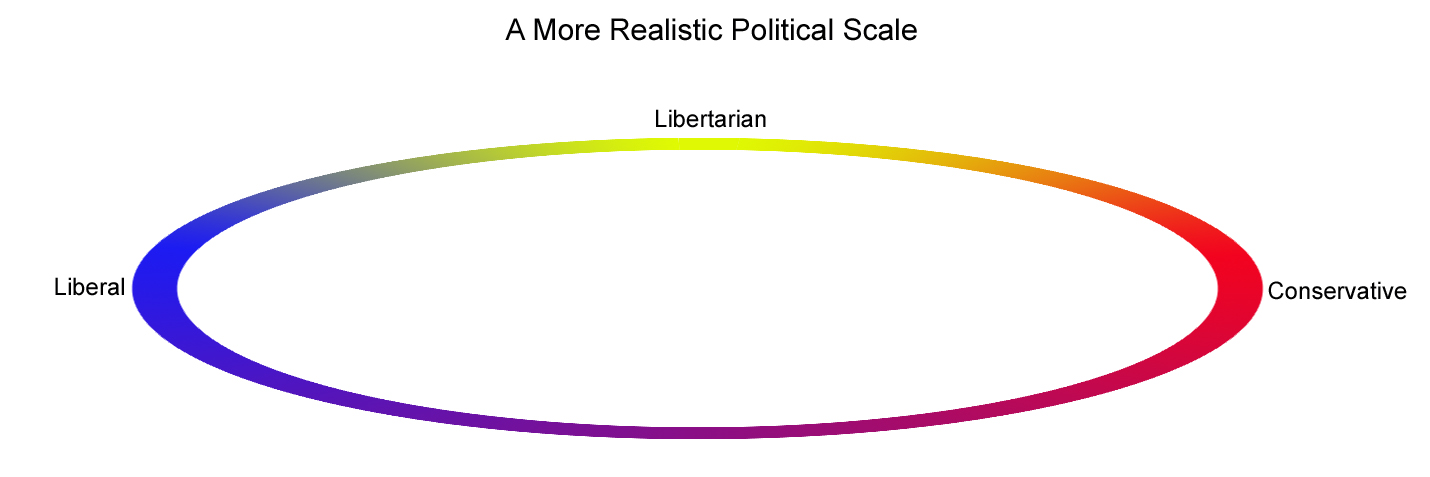
Many people view politics as a one-dimensional model. Like the image above, a person or politician would fall somewhere on the line between hardcore conservatism or hardcore liberalism. Although this model would include moderates--who would fall somewhere near the middle of the scale--it completely ignores those with libertarian views. These people are generally fiscally conservative and socially liberal. The two-dimensional graphic below would be far more accurate.

Both of the models above fail to acknowledge some of the most influential political forces. The image below is a representation of how I view the US political model. The two dimensional model at the equator of the sphere is where the strict ideologues would be found. Forces such as corruption, a desire to maintain elect-ability, deeply-held biases, etc., pull politicians away from that equator. They exist somewhere in the sphere where their political loyalties and core beliefs are compromised by these other factors.

When we look at the one or two dimensional models, we simply judge politicians on how liberal, conservative, libertarian or moderate they are or claim to be. But if those ideals are severely compromised by corruptive influences, it really doesn't matter how liberal, conservative, libertarian or moderate the person is. The politician will pursue an agenda that is inconsistent with the political ideals of the group they ascribe themselves to.

It is far more important to evaluate a politician based on the forces that drive their behavior than it is to evaluate them based on their party affiliation.

For instance, Republicans claim to promote economic growth by being "business friendly" and making opportunities for oil companies and other large corporations to expand and create more jobs. But is this their policy because they honestly believe that this is the best remedy for the country's economic crisis? Or is it because most Republican politicians are heavily invested in oil companies and other large corporations? Is it because oil companies and other corporations will contribute generously to their next election campaign if they can promise and deliver policies that will make those corporations more wealthy?

Democrats claim to support the middle class worker but they seem to provide a lot more support to people on Wall Street. Is that due to their personal financial investments in Wall Street banks? Is it for the campaign contributions they receive from Wall Street? Does anyone recall that while Countrywide was swindling home buyers and writing bad mortgages, the politicians in Congress that should have been regulating their business were not doing so? They were, however receiving great deals for their home mortgages from Countrywide. Isn't that a conflict of interest that we should never allow to take place? Do Democratic politicians "support" workers for the campaign contributions from unions? Do they do it for the votes that the unions deliver on Election Day?

One-dimensional thinking affects our understanding of political events as well. One example of a one-dimensional view is the statement that "terrorists hate us for our freedom". That may be true but it is not why they are attacking us. There are many geopolitical reasons for the attacks and it can't be so easily explained away. Until we understand them, terrorist attacks are likely to be a forthcoming.

Another one-dimensional view is the idea that business people would make the best politicians. Being able to balance a budget is an important skill for government workers to have but look at other aspects of the job. Are business people generally aware of the protocols of holding an elected office? Do business people generally empathize well with others? Business people generally succeed when they gain an advantage in a deal whereas a good politician needs to find equitable solutions that work for the benefit of all parties. Also consider that wages--like any other commodity--are subject to the laws of supply and demand. Business people profit when jobs are scarce and demand for them is high because that allows business people to freeze or lower wages. If a business person's cronies are other business people, will they be likely to work hard to create more opportunities for employment to better the country or will they keep unemployment high so that their cronies (and perhaps they, themselves) can benefit from suppressed wages?

For this country to move forward, we need to break out of the box. Republicans will give you a game plan to move the country forward and the Democrats will give you an alternative plan. But we don't have to choose one or the other. We can demand other options. And, if we think multi-dimensionally, we can identify solutions that will actually work for the country as a whole, instead of just for the politicians and their cronies.

~R. Charan Pagan
information systems technologist, musician, writer, filmmaker
Los Angeles, CA 90017

http://www.reclaimingourbirthright.blogspot.com/

Wednesday, July 10, 2013

Identifying and Avoiding the Danger Ahead


Are we too distracted to know and understand the danger ahead?
Does anyone really think that our politicians suck because they;re too "liberal" or too "conservative"? Do you think that maybe it's because they're all beholden to interests other than yours or mine that their job performance is unsatisfactory?

I don't see many politicians I would call either liberal or conservative. If we had a liberal party it would be an anti-war party. And if we had a conservative party it would be fiscally responsible. Instead, we have Democrats and Republicans and just look at what they have accomplished over the past several years. It has not been pretty.

What is the best course of action?
If you are standing on a ship headed for an iceberg, does it matter whether you're on the port side or starboard side? Would you chain yourself to one side or would you rush the bridge, take control of the vessel and steer it clear of the danger? Understand that the primary danger ahead of us is not a mass of bad liberal ideas or bad conservative ideas. It is an iceberg of corruption, of plutocracy and of duopoly. If we cannot focus on avoiding that obstacle, or obliterating it, then we are sunk. Plain and simple.

We are not going to eliminate corruption by electing more Democrats or more Republicans. We are only going to eliminate it by addressing it ourselves, together. Politicians are not going to work to eliminate corruption. Most of them profit from it. Others enjoy the sense of power that comes from having the ability to take your tax dollars and hand them to their cronies.

Are we going to continue to tolerate the corruption or will we do something about it? Click here to read about how a 21st Century Continental Congress could be created to reform government and eliminate corruption. It would take a  lot of work but it would be successful. ...if we find the motivation to change the system to benefit us. Otherwise, we wait for the special interests, the plutocrats and the duopoly to wrangle over who gets our tax dollars and how much of it we get to keep. Why would you ever consider leaving such decisions in their hands?

~R. Charan Pagan
information systems technologist, musician, writer, filmmaker
Los Angeles, CA 90017

http://www.reclaimingourbirthright.blogspot.com/

Wednesday, June 26, 2013

How the 1% is Hurting the Country (part 2)

In my last blog post--How the 1% is Hurting the Country (part 1)--I linked to an article that explains how the country has been harmed by those whose wealth is used to influence politics in a way that is unfair to the majority of us. That article very brilliantly enumerates the ways that this oligarchy has been detrimental to the greater economy and even to the long term interests of those in the so-called 1%.

The aforementioned article offers some great insight into the macroeconomic issues facing the country. This week, I'd like to focus in on a microeconomic aspect that ties into the previous article and illustrates the stark danger of the plutocracy that our country has become.

So, imagine that there is a business in a community and the business is doing well, paying all of its employees and therefore the entire community is thriving because everyone is working and everyone has money to spend. Then let's say that someone sees this all going on and decides: I would rather have all that money for me! That person buys the company, runs up its debt to pay himself hundreds of millions of dollars then, when the business cannot repay the new debts, closes the business, fires the workers and files for bankruptcy, hanging the company's debts on the taxpayers (some of whom were just fired from the company). Seem fair?

Of course, that scenario is not hypothetical. It is how private equity firms, like Mitt Romney's Bain Capital, sometimes operate. I bring it up because I often see comments from people online, suggesting that people who voted for President Obama may now be regretting their vote, as if Romney/Ryan was a viable alternative. I also bring it up because people still blame the poor economic recovery on the housing bubble, bank bailouts, the "takers" getting too much welfare, Obamacare, the wars, etc. Although most of those things may also be to blame, the business practices of private equity firms is certainly one of the most destructive forces and it is an issue that desperately needs to be addressed. It is also an issue that is largely ignored by the mainstream media, while people are all-too-eager to talk about the other possible causes. We are not going to have a strong economy again as long as people are more inclined to chase large, short-term profits as opposed to long-term growth and stability.

Personally, I could not vote for a person like Mitt Romney. The types of business practices he was involved in at Bain should be illegal. We certainly don't need a president that champions such business practices and might perhaps help others make out the way he did: by essentially stealing wealth from the common worker.

This relates to Joseph Stiglitz' article because, through the magic of plutocracy, such unethical business practices have not only been made legal, but the profits from such travesties are taxed at a rock-bottom rate, far lower than you or I pay on our income we receive from working and producing things. You see, when you or I request things from government--like tax relief, clean air and water, transparency and accountability in government, etc.--government usually yawns. But when a very wealthy and powerful person approaches government and asks to legalize theft and then get a sweetheart tax break on those ill-gotten gains, the government tends to listen and bend over backwards (and bend us over forward) to accommodate them.

We citizens in the so-called 99% are the majority in this country. And it is supposed to be a democracy. Therefore, if the majority of us are intelligent, we could come together to demand changes to the system so that it is no longer rigged against us; we can make destructive business practices illegal and we can make profits from "carried interest" deals taxed at the full rate. If...

~R. Charan Pagan
information systems technologist, musician, writer, filmmaker
Los Angeles, CA 90017
http://www.reclaimingourbirthright.blogspot.com/

Wednesday, June 12, 2013

How the 1% is Hurting the Country (part 1)


Can you afford a lobbyist? Will you get a fair shake without one?

I would like to share a link to a single article that I believe every American should read. The article puts some intellectual firepower behind the discontent of the 99% movement, which they themselves could not articulate and most did not fully understand: that the country has become a plutocracy which harms democracy, justice and fairness. Furthermore, the greed of the 1% and the income and wealth inequality that currently exists in the US is not only harming the country and many in the 99% but it is harming the 1% as well. Since people in the 1% control almost all of the news media in the country, they were able to mis-characterize the 99% movement as lazy free-loaders. Similarly, they re-directed the anger of the TEA Party movement from the abuses of big banks to instead demanding from government that the taxes on the rich can never be raised. The article brilliantly explains why our current economic structure is bad for everyone, including those currently benefiting from it.


~R. Charan Pagan
information systems technologist, musician, writer, filmmaker
Los Angeles, CA 90017
http://www.reclaimingourbirthright.blogspot.com/